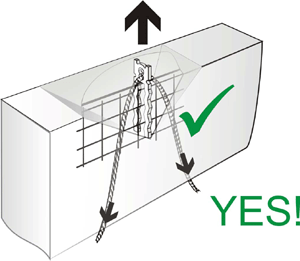




MYTH: Shrinkage steel increases anchor loads
Calculate load transferred to the panel at the anchor: AS 3850 requires that the Working Load Limit contain a factor of 2.5 against the ultimate load capacity of the anchor resisting the lifting load: i.e. 7*2.5 tonnes = 17.5tonnes force = 171.5kN (AS3850) Now, the concrete strength limit state ~ 7 tonnes = 69kN Conclusion: additional reinforcing is required! This could be achieved either by:
Preferred method: Use a hanger bar directly attached to the anchor (eye anchor). The load is transferred directly from the lifting anchor to the hanger bar to shed the load directly to the concrete away from the edges, deep within the panel and. The required hanger bar is N16 of total length 1400mm (see HOW TO of hanger bars). Total additional mass steel: 2.2kg
Now check the non-preferred method: Add panel reinforcing specifically to resist the lifting loads Suppose it is decided to add additional reinforcing to enable the panel to withstand the additional stresses without relying upon the shrinkage or other reinforcing.
In this case the lifting loads are transferred to the additional reinforcing steel bars through the (cracked) concrete itself, relying upon adhesion and concrete interlock between the anchor, cracked concrete and the reinforcing steel. Place additional steel bars parallel to the anchor in the vicinity of the anchor to trap the load and shed it into the panel. Additional steel area required: Ast = 171.5kN * 1000 / 500MPa / s = 171.5*1000/500/0.8 = 343 Squ mm. Suppose N12 bars (113mm2 cross section) Require 4 bars to meet the requirement. Calculate the required Development Length from AS3600 From AS3600 Lsy.t = k1 k1 fsy Ab / (2*a + db) √ f’c and Lsy.t ≥ 25k1db Now, for k1=1, k2 = 2.4, Compressive strength f’c=15MPa (at the time of lift), Bar diamenter db = 12, Bar Area Ab = 113, Cover or distance between bars a=30mm Lsy.t = 486mm ≥ 25k1db (300mm) Note 1: AS3600 requires this embedded length either side of the point at which the stress exists i.e. either side of where the concrete cracks at the base of the lifting anchor. This is to ensure that the reinforcing bar cannot pull out of either the edge strip where the anchor is located or the body of the panel below the crack. Since the typical anchor lengths are 250-450mm long and so with required concrete cover of 30mm, it is not possible to guarantee sufficient embedment in the edge strip unless the bars are cogged or terminated with standard hooks. Distance to the bottom of the hook or cog = 243mm, Required cover = 30mm Check whether it is possible to develop the bars in the lifting strip: It is possible (but not efficient!) to provide additional steel reinforcing around the anchor specifically to reinforce it against the additional loads generated during lifting provided that 4 additional N12 bars are used 486mm long with a standard hook on the end nearest the edge of the concrete (overall length of each bar including the hook = 486+273+75 = 834mm) i.e total additional length of reinforcing bar = 3336mm (2.96kg)! Conclusion: a hanger is more efficient, not only saving .75kg steel but less cost to manufacture and place and in addition, the load is shed deeper into the panel and further from the panel edges. |