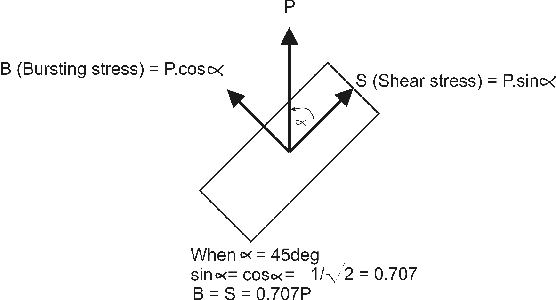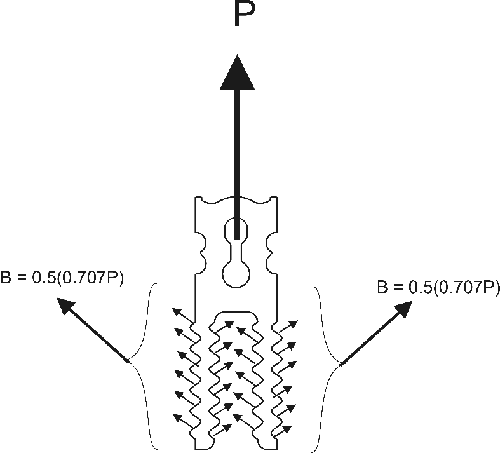




MYTH: Flat sided anchors (with internal serrations), Newton's third law of motion states that to every action there is an equal and opposite reaction. It is also a fundamental property of elastic solids that applied loads are resisted by stresses in all directions i.e. parallel to the direction of the load and at right angles to it.. In the case of an anchor in a concrete panel, the applied force is resisted by equivalent tensile and shear stresses in the concrete about a slip plane at 45degrees to the anchor axis. Effectively, the stresses result in shear stress along the slip plane and a “bursting” force acting at right angles to the plane (45degrees to the anchor axis) in all directions around the anchor, no matter what the shape of the anchor.
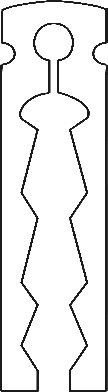
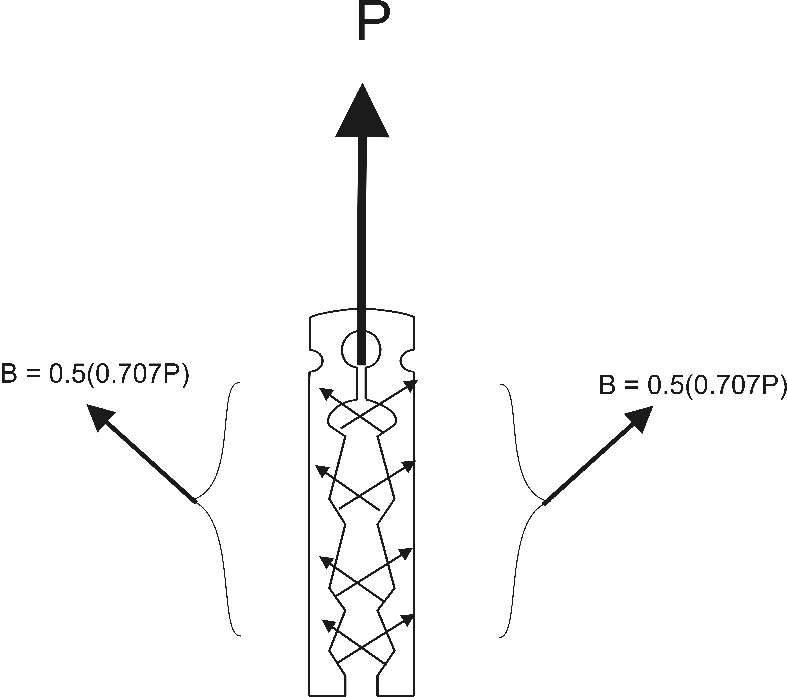
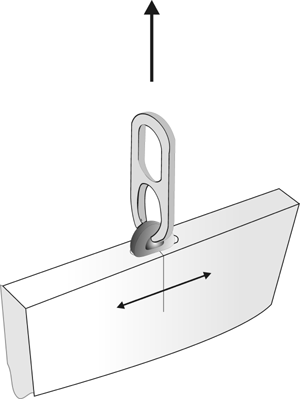
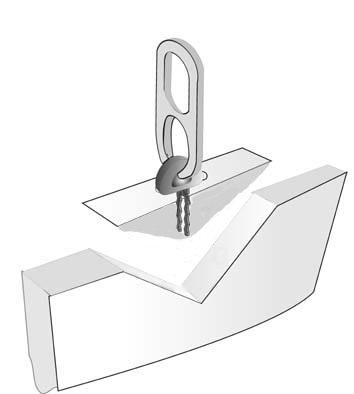
The diagram shows that no matter how the stress is transferred to the concrete, bursting forces will occur! Lets see how an anchor “leg” with serrations works (same principle as a reinforcing bar!): Anchor load is resisted by the concrete at the first deformation closest to the surface. When the stress exceeds the strength of the concrete at this point, a micro-crack develops and some of the load is shed to the next point of resistance along the anchor and so on. When the load reaches the bottom deformation, there being no further mechanism to shed load, increasing the load propagates the crack from the bottom of the anchor and the concrete pulls out in a cone (because the stresses are in three dimensions). In the case of a thin panel, the pullout “cone” is truncated into a “pie” shape or else a thin panel may fail by splitting along the panel at right angles to the anchor axis if the panel is weaker in this direction (splitting failure). Now consider the difference between one type of "hairpin” anchor with flat sides and internal serrations and another type with serrations cut on the inside and outside edges of each leg.
The load from each and every serration results in concrete stresses at 45 degrees in all directions about the anchor axis, whether emanating from the inside or the outside of the anchor leg (the concrete cannot distinguish the difference!)
The total load transferred is the same but the load per serration is dependent on the total number of serrations sharing the total load. A flat sided anchor with half the number of serrations imparts twice the load at each serration as an anchor with serrations on both sides. In fact, the higher specific load in the concrete at these serrations could be a disadvantage because they could result in local crushing of the concrete, loosening the adhesive “grip” of the anchor (particularly in low strength concretes e.g. 15MPa at time of lift). A calculation is helpful here. Consider a load of 7tonnes applied to an anchor in concrete panel, lifted at 15MPa compressive strength.
Case A: legs externally flat with 4 internal serrations on each leg
Case B: 6 internal and external deformations per leg:
Now consider the stresses arriving at the surface of the panel. The same total stresses are felt in the concrete at any point beyond the bearing surfaces of the anchor (Newtons third law!) At the surfaces close to the anchor, the (total) stresses in the concrete induce the same magnitude of plane strain which ultimately causes a tensile splitting crack along the anchor axis. This occurs at the same load regardless of the anchor shape!
The stresses arriving at the concrete surface cause the same degree of cracking and cone failure in the concrete occurs at the same ultimate load. This has been verified in tests.
Hence there is no definitely no advantage and depending upon the design there could be a disadvantage for flat sided, internally serrated “hairpin” anchors, despite the sales spin! |